Monday, February 18, 2013

Ba Be Lake – A haven of serenity

Ba Be, a pearl amidst the evergreen Tay Bac forest, is considered a must-visit destination with its splendid landscape and mystical legends. The beautiful lake in the northern province of Bac Kan is listed as one of the world’s 20 largest freshwater lakes in need of preservation.


After departing from the capital city, the passenger car took me to Bac Kan Town on Road 3. Viewing the passing hamlets in the car, I was sunk in divergent legends of Ba Be Lake. One legend says that this area used to be a very large valley sheltering the Nam Mau Village. Each year, the villagers gathered to hold an offering ceremony for Buddha. 

One year, a leprous old woman came to the ceremony but was neglected and asked to keep away from the others. Luckily, a widow welcomed her and gave her food. The old woman, who later turned out to be a fairy mother, paid respect by granting the widow a handful of ash and a seed of rice.

The next day a monsoon overwhelmed the valley but the hoof the widow was somehow raised above the water line and protected. Following the fairy mother’s words, the widow scattered the handful of ash around the hoand water could not flow into her house; she threw the cover of the rice seed into the water, and it turned into a dug-out canoe which helped her float.

After that, the flooded valley turned into three lakes which today form Ba Be Lake. Ba Be, meaning three lakes, was created by the confluence of river tributaries Pe Lam, Pe Lu and Pe Leng (Pe means Lake in Tay language) after earthquakes tens of millions of years ago.

Passing through the reed grasses, downstream from the serene Nang River, I saw many dug-out canoes like the kind mentioned in the legend. For local people living along the Nang River and Ba Be Lake, they are popular means of transportation. A dug-out canoe looks like the cover of rice seed. It's dedicated and long. It can glide fast and even downstream without energy-consumption, and it never leaks. Dug-out canoes are indispensable when people want to catch small fish in the lake.

The canoe drifts through the bends of the river and past scenic high cliffs through Lung Nham Mountain to reach Puong Cave. Inside the cave with the poor light there exist many stalactites in different shapes overhead. Ba Be Lake is surrounded by many ancient trees, from which several varieties of precious wood are obtained. Up to 30 animal species such as wild pigs, bears, panthers, monkeys, and birds inhabit the area. Scenic high limestone cliffs around the lake with the height of several thousands of meters look like skyscrapers amidst the city. Along the two riverbanks lie many hamlets of the Tay, Red Dao and White H’mong ethnic minorities.

Riverside trees swayed in the wind to welcome me back to the crossroads between the Nang River and the way to Ba Be. I turned right into the tributary of light blue water and then headed for Ba Be Lake which is 4km from the cave. The 8km long and 3km wide lake covers an area of 650 hectares. According to scientific research, Ba Be Lake was formed approximately 200 million years ago due to geological constitution. The lake, located 145m above sea level, is surrounded by limestone cliffs. This biodiversity reservoir is the habitat for fauna and flora thousands of years old. The surface of the lake is so tranquil that people can see even see the lake bed. It is home to 106 fish species and is surrounded by many ancient trees.

After having taken a tour around the lake, I went to visit a temple on An Ma Island to offer incense. On the way back, I stopped to enjoy wine and fried fishes made by local women at a tent at the Ba Be lakeside. With its original and unspoiled landscape, Ba Be still offers a haven of peace and tranquility away from the bustle of city life. In addition to the river and lake tour, visitors can trek to local villages where Tay and Mong peoples live and keep their traditions.

Further information: 
Ba Be Lake is nearly 300km from Hanoi and 50km from Bac Kan municipality. From Hanoi, you can drive motor or take passenger car to Bac Kan. Upon arriving in Bac Kan, drive further 35km to reach Ra market, turn left onto National Highway 279, then travel another 10km to arrive at Ba Be Lake.

Tourists can stay at guest building of Ba Be National Park which is price at 200,000/2 persons per room; or stay at stilt hoof Tay ethnic minority in Pac Ngoi and Po Lu hamlet with the price of VND15,000-20,000/person.

Famous specialty here is fish hot-pot, fried fish, roast chicken and goat meat enjoying with local sticky rice. Tourists will have the opportunity to take part in many folk games performed by local artists. In addition, visitors will have an unforgettable stay in the mountains by the lakes, enjoying sightseeing boat trips, hikes, water sports, and discovering the traditional customs of different ethnic minorities in the region.

Thanh Hai Water Puppetry

Water puppetry is a mainstay of the performing arts in Viet Nam. In villages, it is often performed on the pond that is located close to the communal house and attracts thousands of spectators from near and far.
  • As the lunar year draws to an end, members of the Thanh Hai Puppetry Troupe in Thanh Ha District in the northern province of Hai Duong, jump into action and diligently prepare for their upcoming performances. Preparations not only include rehearsing, but also maintenance on the puppets.

    With its more than a 300-year-old history, Thanh Hai water puppetry is performed at most major festivals and celebrations nationwide, including the cultural festival in Hue, the National Water Puppetry Festival and the yearly Hung Kings’ Temple Festival. Stories about the Thanh Hai Water Puppetry Troupe, which includes an outstanding collection of amateur performers and has won numerous prizes for their programme, attract the attention of researchers, cultural organizations and individuals interested in the art of Vietnamese water puppetry.


Thanh Hai water puppeteers standing in water behind a bamboo curtain manipulate the puppets.
Water puppetry performances mainly reflect the daily activities and life of residents living in the northern river delta. Nguyen Van Huan, who was head of Thanh Hai Water Puppetry Troupe, said: "Thanh Hai water puppetry has developed over hundreds of years thanks to the local villagers who wholeheartedly support this art of their native homeland and to the devoted performers who constantly renew the vitality of this traditional art."

Pham Khac Xoa has manipulated the puppets since he was a little boy. Now at 36, he is entrusted by the elderly villagers to be head of the troupe. Xoa said: "Experience handed down to us from the elderly villagers-performers is an invaluable treasure. We want to keep the troupe alive, so often exchange ideas with other troupes around the country. By doing so, we preserve and develop this traditional art.”


  “Legend of the Sword Lake” item
Water puppetry certainly isn’t an easy art to perform. The show is held in a pond or lake, and the puppeteers have to stand behind a bamboo curtain and in water, sometimes waist deep. The puppet is attached to the end of a long bamboo pole that has a string or cable running up the centre of it that is pulled or pushed to control the puppets' hand and leg movements.

Thanh Hai water puppeteers have regular meetings to rehearse the old repertoire, compose new skits or make new puppets. Starting with only five acts, Thanh Hai troupe has now a rich repertoire with dozens of acts, some of which are very unique and had won prizes at the national puppetry festivals, such as the frog-catching man, tiny firecrackers, going-to-the-field festival, etc. It also has hundreds of puppets for diverse and interesting performances.


   “Fishing”
Thanh Hai troupe now has 36 members, of whom 18 members often go to perform in many localities, including Hanoi, Hai Phong and Quang Ninh Province. In recent years, the troupe participated in many festivals nationwide, including Thua Thien-Hue Provincial Puppetry Festival and the National Puppetry Festival. In 2005, at the First National Amateur Water Puppetry Festival, the Thanh Hai Water Puppetry Troupe was awarded the First Prize. The success has been attributed to the great effort made by the local water puppetry artisans and performers.


 “Procession of Firecrackers”
Like other villages in the Vietnamese northern delta having symbolic images, such as the communal house's steep roof, the landing place and the old banyan tree, Thanh Hai Village is further known for its long-standing water puppetry performances. During the village festival or other celebrations, there is always water puppetry shows with animated puppets, cheerful music and skilful performers, who are hard working farmers, and optimistic and skilful artists at the same time who help in preserving the traditional art of water puppetry.

Xa Loi Pagoda - The First Pagoda of Ho Chi Minh City

Xa Loi Pagoda was established to worship the Great Buddha and it is known as the first pagoda of Ho Chi Minh City and also a rather modern pagoda. Tourists in Vietnam travel visiting Xa Loi are interested in its beauty of new architectural style with an altar above and an amphitheatre staying lower.

 Xa Loi Pagoda- The First Pagoda of Ho Chi Minh City
Xa Loi Pagoda is a large pagoda and also a relic at the city level of Ho Chi Minh City, lying at the corner of Ba Huyen Thanh Quan Street, District 3 with the huge precinct of 2,500 square kilometers.
The pagoda was started to build on August 5th 1956, following the drawing of the architects Nguyen Van Duong and Do Ba Vinh. And the engineers Du Ngoc Anh and Ho To Thuan were responsible for the construction site. The pagoda building then was finished on May 2nd 1958.

The pagoda was established to worship the Great Buddha and was called with the name "Xa Loi" for short by common people. For that reason, in inaugurating day, the superior Buddhist monk has named it "Xa Loi Pagoda".

This pagoda used to be the main headquarters of the Association of Buddhology of Vietnam from 1951 to 1981. After that, from 1981 to May 1993, it became the headquarters of Buddhist Church of Vietnam (the second office).

Xa Loi Pagoda is the first pagoda of the city which was built in a new style of architecture with an altar above and an amphitheatre staying lower. The design of the pagoda includes a sanctum worshipping Buddha, an amphitheatre, a bell tower, a library, monks' quarters, purifying house, office, a room publishing prayers and bibles, guests' room and an area for travelers staying.

The pagoda worships a huge statue of The Sakyamuni which is made by the School of Fine Arts Bien Hoa. In 1969, the statue was restored with the whole body made of gold and has the shape like today. The sanctum at the upper floor is decorated with a set of big pictures including 15 pictures created by the professor Nguyen Van Long of the School of Fine Arts Gia Dinh. Those pictures have described the life of the Sakyamuni, from newborn time to the time of entering Nirvana.
 Xa Loi Pagoda- The First Pagoda of Ho Chi Minh City
Xa Loi Pagoda- Ho Chi Minh City
The bell tower Xa Loi was opened in 1961. It is 32 metres high and has 7 floors. This is the highest bell tower of Vietnam. Inside the tower, on the highest floor, there hangs a great bell which weighs 2 tones and was casted according to the model of the bell in Thien Mu Pagoda in Hue.
 You, tourists in Vietnam travel, should not miss to visit Xa Loi Pagoda when you are in Ho Chi Minh City. The pagoda is opened daily from 7 to 11 am and from 2 to 5 pm.

Saturday, February 2, 2013

Ba Danh Pagoda - Beautiful and Ancient pagoda


Ba Danh pagoda is considered one of the nicest temples in the country because of the seaside views and the mountainous surroundings, as well as the architecture of the pagoda itself.


The Ba Danh Pagoda, which has been neglected by tourists for many years, is becoming a more popular attraction.
Among the Vietnamese, the temple has been knows as the “Deserted Pagoda” for a long time. But now things are changing. Nowadays the pagoda has been playing host to many visitors.
To get to the pagoda, located in Ha Nam Province, you must take an 8km boat ride.
Although it has been passed over for a long time, it is still considered one of the nicest temples in the country because of the seaside views and the mountainous surroundings, as well as the architecture of the pagoda itself.
Actually, more than a pagoda, it is more of a complex, covering 10ha and more than 40 separate structures.
In the 7th century, the pagoda was a small temple, which was upgraded during the Le Dynasty. In 1994, Ba Danh Pagoda was granted a certificate as a national historic monument by the Ministry of Culture.
In 2007, the province invested another VND20 billion (USD956,937) into the restoration.
Last September, the pagoda opened a large guesthouse to serve tourists.
Monk Thich Dam Dam said “The pagoda is no longer deserted. Sometimes we receive hundreds of visitors a day. Many of them come back over and over.”
Ba Danh Pagoda’s festival is held on March 25 and 26.

Wednesday, January 30, 2013

Cu Chi Tunnel – Underground Walks


Journalist of The World Geography had interesting experience in Cu Chi Tunnel and voted this building the 5th among 10 most breathtaking underground in the world.

1
“Crawl through a small trapdoor into narrow, stifling tunnels and enter an “underground village” with kitchen, dormitory, meeting room, and hospital. During the Vietnam War (1954-75) thousands of Viet Cong were based in the 125-mile (200-kilometer) network of tunnels. The “village” was never captured despite being bombed many times”, described The World Geography.
Cu Chi Tunnel is a defense system in the underground, located in Cu Chi district, Ho Chi Minh City. This project was initiated construction in 1940 in the war against French enemy and it lies at the end of Ho Chi Minh path. Currently, this tunnel is an alluring destination for the tourists to visit and discover one history period of Vietnam.

Saturday, January 26, 2013

Beef Fried with Giang Leaf

Giang leaf is not a manual kind of vegetable that people grow in family garden, also not a rare and specious one. It is just a type of vines which has dark green color, living on rocky cavities in the mountain slopes.

Beef Fried with Giang Leaf From past to now, beef fried with giang leaf has been a typical dish of people in the edge region of the commune, especially in Vinh Te-Nui Sam, Chau Doc where there is an annual traditional festival attracting millions of inbound and outbound guests.  

Actually, the appearance and the creator of the dish beef fried with giang leaf have not been defined. Giang leaf is not a manual kind of vegetable that people grow in family garden, also not a rare and specious one. It is just a type of vines which has dark green color, living on rocky cavities in the mountain slopes. It has no typical smell but tastes fresh sour, including a rich amount of vitamin C. Giang leaf grows most in the rain season. 

When being tried, beef fried with giang leaf specifically provides diners with a very special taste. From old people to young girls in Binh Dinh, all know the way to cook this rustic dish which is not sophisticated but very simple and traditional.

Fresh beef is sliced thin then treated with spices. Giang leaves are sliced into threads. People take several hand scoops of sliced leaves, some coconut juice and crushed roasted peanuts to dust onto the dish. The smoke is very good-smelling. If being served with Go Den wine, this simple dish will become one of the most wonderful dishes in Southern delta region.

Despites of being a wild vegetable, giang leaf has a high cuisine value. In Binh Dinh, people usually use giang leaf to make soup instead of star-fruit, tamarind or fermented rice because it is very good-smelling, sour and can be used for treatment. Giang leaf is sold in the market but not anytime.

Sunday, January 13, 2013

World's longest cable hanger in Vietnam

Vinpearl Land Cable Hanger is over Nha Trang sea, connecting Nha Trang with Hon Ngoc Viet tourism area on Hon Tre island. This is the world's longest Hanger and it can contain the most people in one cabin.

The construction started in August 2006. After more than 14 months of building, the Hanger Cable was put into operation on March 10, 2007. On every viewing corner of Nha Trang city, the tourists can see a system of cable hanger with 9 cable pillars having the shape of Eiffel tower in France. 

The Cable Hanger is 3,320 meters long with 9 pillars, the highest of which is 54.65 meters, the shortest is 7.96 meters. Its total weight is up to 7000 tons. However such equipments like gas station, cabins..imported from France are counted for one fourth of the total 200 billion dongs ($10 million). It is nearly considered absolutely safe.
Vinpearl Land

The cable hanger is designed to have 65 cabins, serving 1500 tourists per turn every hour. Each cabin will run through the route between Nha Trang and Hon Tre island for nearly 9 minutes 20 seconds. The hanger can withstand the level 7 wind, the maximum compensation cost for an accident on one cabin is 12 billion dongs ($600.000).
Vinpearl land

Seating on the Vinpearl Cable Hanger at the height of 54 meters, the tourists can view thoroughly the marine city and Nha Trang Bay, one of the world's most beautiful bays under a strange view. This Cable Hanger took the interest of a lot of people while being under construction. Based on the length, the Cable Hanger is considered to be the longest in the world and is able to receive Guiness world record. For this reason, Discovery Channel sent one responsible team to record first images of his Hanger.  

Vinpearl

In addition to the stretching wonderful beach, recreational areas that the nature gifts, the Cable Hanger Vinpearl Land adds one more reason for the local as well as foreign tourists to choose Nha trang as their destination.

Love Waterfall in Sa Pa

Sa Pa is not only well known for the charm of being a misty mountain town with terraced rice fields stretching continuously on the mountains, but also for its romantic waterfall called Love.
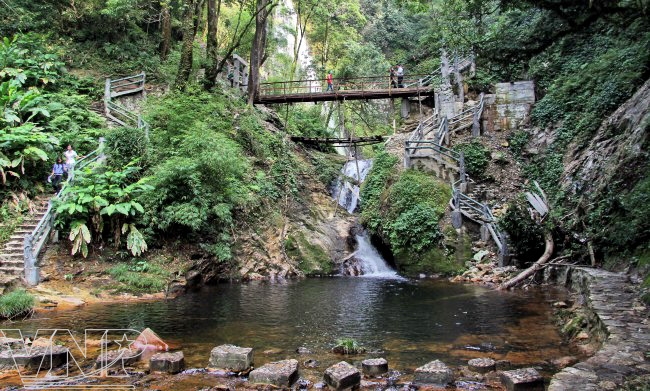
Love Waterfall, located about 4km to the North-West of Sa Pa Town in San Sa Ho Commune, Sa Pa District, Lao Cai Province, is a “must-see” destination on the Sa Pa tour. Driving on a red soil road to the waterfalls that winds through a primeval forest of lush ancient ivory trees and rhododendron flowers in white, red and yellow colour, tourists have a chance to enjoy a perfect painting-like landscape.
  The beautiful scenery at the foot of Love Waterfall.

From afar, the waterfall looks like a twinkling pyramid under the sun. It has a height of about 100m, and starts from the peak of Fansipan Mountain and rush noisily into the Gold Stream like a never-ending song. Under the waterfall, the Gold Stream runs along with green grass plots and bamboo clusters, forming a poetic image.
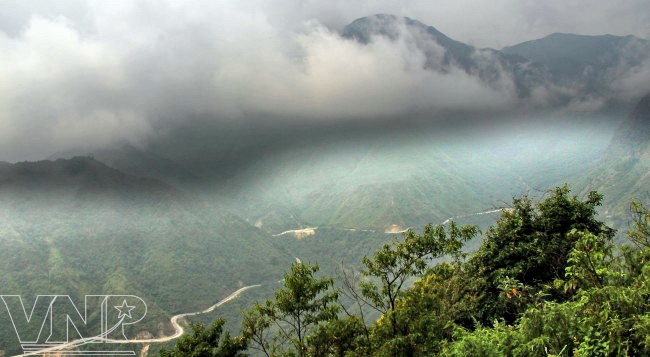
Love Waterfall is part of the tour to the imposing mountain range of  Hoang Lien Son.

According to the local people, the name of the waterfall originates from a love story. Legend has it that long ago, fairies from heaven used to come to the waterfall to bathe. One day, the seventh fairy saw O Qui Ho, the first son of Ai Lao Mountain Genie who was playing his flute near the falls.
The Waterfall is a popular destination in Sa Pa.

Mesmerized by the flute sounds, the fairy spent every night listening to the sweet melodies until her parents detected her secret and forbade her from coming to the human world.The fairy missed O Qui Ho so much that she spent every afternoon at heaven’s gate looking towards the waterfall and waiting for the sounds of the flute. Then, she transformed herself into a yellow bird that lives on O Qui Ho Mountain. Since then, the waterfall is called “Love” to remind everyone of the legendary love story.
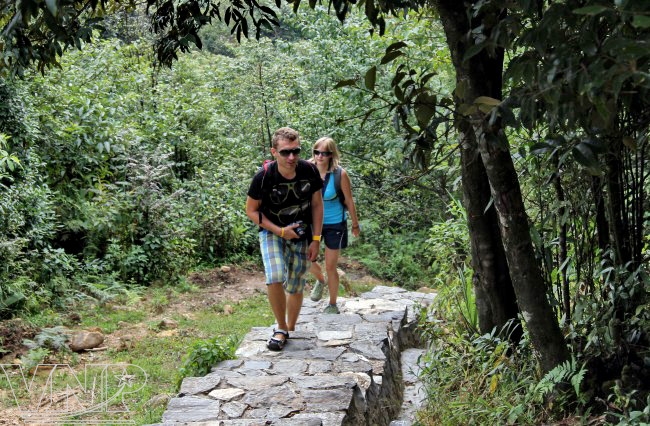
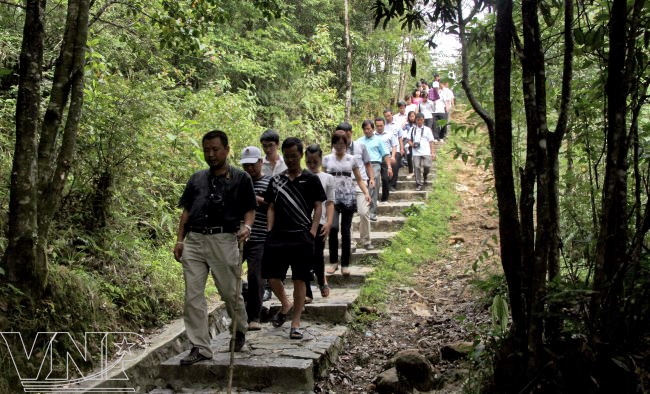
On the way to Love Waterfall, tourists discover the beauty of a primitive forest. 

Currently, the Netherlands Development Organization (SNV) has suggested listing Love Waterfall in the “West-North Route” tour as it has a promising potential to become one of the most attractive destinations in the mountainous district of North Vietnam.

Beautiful scenery on Ly Son Island


Only a few people know that Ly Son Island in Quang Ngai Province in Central Vietnam was d from five extinct volcanoes during the prehistoric age. With wonderful scenery left by these volcanoes, the island has now become an alluring destination, attracting a large number of tourists.
Seen from the shore on a fine day, Ly Son Island looks like a pyramid on the sea with its top being the peak of Thoi Loi Mountain. Among five mountains founding on the island, Thoi Loi is a rocky one. After a long time climbing the tortuous path on the mountain, tourists reach the peak of Thoi Loi where they have a panoramic view of the garlic field that looks like a chess-board and an immense blue sea dotted with fishing boats in the distance.


A panoramic view of Gieng Tien Mountain from the peak of Thoi Loi Mountain. Photo: Viet Cuong

The road to the peak of Thoi Loi Mountain. Photo: Thong Thien

At the foot of Thoi Loi Mountain. Photo: Viet Cuong.

Duc Pagoda is located halfway up Gieng Tien Mountain. Photo: Thong Thien

The cold lava from the exinct volcanoes millions of years ago forms a beautiful scenery. Photo: Viet Cuong

A garlic field at the foot of the mountain.

The rain-water reservoir built on an area which was formerly a primitive forest. Photo: Viet Cuong

"The Heaven Gate" was formed by the cold lava from the exinct volcanoes millions of years ago. Photo: Viet Cuong

Beautiful cliffs near Hang Pagoda on Ly Son Island. Photo: Thong Thien
According to the old people in Ly Son, the hollow of the extinct Thoi Son Volcano was formerly a primitive forest of different valuable trees and had abundant fresh water resources which ran at the foot of the mountain to form Chinh Stream. Then, the forest was totally destroyed and the stream no longer exists. So far, there is only a relic left – Hang (Cave) Pagoda. Due to the sea’s impact on geology for hundreds of years, the layers of rock have been eroded and have formed a cave in the shape of a pagoda.

Unlike Thoi Loi Mountain that has only rocks, Gieng Tien Mountain has a special fertile soil, similar to the Bazan soil in Tay Nguyen (the Central Highlands). The locals often use this soil and sand to fertilize the garlic fields. Thanks to these fertilizers, the variety of garlic grown in Ly Son has a special flavour that is hardly known in other places.

 Around the crater of Gieng Tien Mountain that is smaller than that of Thoi Loi Mountain is a piece of land where no plants can grow. According to the beliefs of the locals, it is the sacred oil that was used as ash on the graves of soldiers of Kiem Quan Bac Hai Squad who laid down their lives when protecting the Hoang Sa (Paracel) Islands during the reign of King Minh Mang (1791-1841).

The remaining part of Gieng Tien Volcano.

  A colorful stone on the mountain.

At the peak of Thoi Loi Mountain .

The way to Duc Pagoda.

To the east of Gieng Tien Mountain is a strange pagoda, called Duc by locals. Visiting the pagoda, tourists learn a story about the Goddess of Mercy who traveled on Bac Hai Sea to save fishermen in distress. Seeing fishing boats being sunk by storms, she tore her robe into thousands of pieces and threw them into the sea.

These pieces of cloth turned into dolphins which saved fishermen on the sea. Due to their belief, the locals made a statue of the Goddess of Mercy, 27m high, facing the sea and placed it at the pagoda with the hope that the Goddess of Mercy will protect fishermen when they go to the sea.

Although the relic of three extinct volcanoes is only small mounds, the presence of cold lava is seen in many places on Ly Son Island, forming a wonderful landscape. They are rocks in different shapes that leave a long-lasting impression on tourists to the island.

Thursday, January 10, 2013

Traveling to bird yard in Ca Mau City

Drived 4 km from Ca Mau, center towards Ly Van Lam Street is 19/5-bird yard. Being springtime, framework of bird yard more and more lyric, poetic. Each year, just on the occasion of Tet, birds gather here again as made a date long time ago.

Ca Mau, city in southern Vietnam is the capital of Ca Mau province, a province in the Mekong Delta region, in the southernmost part of Vietnam's inland territory.The city is characterized by its system of transport canals and most goods are transported here by boats and barges.

For Ca Mau people, bird yard is a pride, in near future, Ca Mau will be the first City which has a bird yard houses with resident. On holidays, especially on the occasion of Tet, birds yard brimful with laughter of tourists. 

Not an end, within the campus of bird yard also has Trau Cau restaurant, which was selected by many inseparated couples to organize their greatest happy day of the life. In a locality as Ca Mau, the establishment, maintainment and enlargement of such an attractive position is very appreciate, encouragable
 

The birds make their nests in tall trees and spend their mornings searching for food; the perfect opportunity for tourists to take out the cameras. Camau Tourist Company has a one-day bird-watching program by boat.

Friday, December 21, 2012

Most beautiful Flowers in Dong Thap


Covering an area of 60 ha, Tan Quy Dong Flower Garden is located in Tan Quy Dong district, Dong Thap province. The garden is famous for the most beautiful flowers but the most precious plants in the South Vietnam as well. There is no doubt that the Tan Quy Dong Flower Garden is one of Dong Thap’s greatest attractions to tourists in Vietnam travel.


In spring, Tan Quy Dong flower garden is covered with new colorful outfit decorated with various types of flowers. Tourists in Vietnam travel gather here to enjoy the fascinating beauty of the garden. Spring is definitely the best time to visit Tan Quy Dong garden during the year, when the weather turns warm with sunshine and gentle wind.
Tan Quy Dong flower garden Dong Thap
The flower garden has many precious plants, some of which may reach the age of hundreds of years old. Strolling around, you may also catch sight of popular trees such as star-fruit trees, fig trees, or areca, etc. As time gone by, under the skilful hand of the craftsmen, these popular trees have transformed into valuable pieces of bonsai arts.
The garden is well-known for its colorful and beautiful flowers which can be found any season, not Spring only. Especially, roses and amber trees are the ones that bring fame to this garden. The garden prides itself on its 50 species of roses such as Black Baccarat Rose, Cleopatra Rose, Elizabeth Rose, Mascara Rose, etc.
Today, when the flower art has become more and more poplular, the garden’s reputation also increases constantly. Surely, whoever joining tours to Vietnam and visiting Dong Thap, the land of pink lotus, feel very pleased.

Snake museum in Tien Giang

Exciting journeys on coconut-lined creeks, enjoying My Tho noodles or swimming in the sea of Go Cong ... are among interesting things that tourists can do in the southern province of Tien Giang.
A unique destination that not many tourists know when they come to Tien Giang, is the Dong Tam snake farm, which is recognized as the first snake museum of Vietnam.

Visiting the snake farm, you will be given the opportunity to explore the lifestyle and activities of these familiar but dangerous reptiles. In addition, you also have the opportunity to admire the collection of specimens of snakes, see how people take snake venom or learn about the method of creating vaccines or medicines for snakebite.


Cai Be floating market, the biggest wholesale market in the Southwest region is pretty well known. Unlike the floating markets of other provinces in the Mekong Delta, the floating market of Cai Be opens all day and night on a large scale. Goods are diverse and abundant. After visiting the floating market, a boat trip to explore the Tien River or small creeks is also interesting.

Tien Giang orchards tourism has famous names such as the Mekong Lodge eco-tourism site, orchards on Thoi Son Island, Ngu Hiep, Dong Thap Muoi eco-tourism zone, Cai Be orchards, etc. There are different names but the common characteristic of the above sites is that they are fruit-growing areas of peace and quietness so you can choose to visit one of them.


Coming to these ecological tourism sites, in addition to walking on cool pathways, visiting coconut candy factories, picking fruits from trees, tasting delicious fresh food, tourists can also transform into farmers to scoop fish or sleep on a hammock.

If visitors have only one day in Tien Giang, they can visit Vinh Trang pagoda, the largest temple of Asian- European architecture mixture. With a long journey (at least two days), they can go swimming in Go Cong or visit a wide range of cultural and historical monuments such as Go Thanh, Rach Gam-Xoai Mut, Ap Bac, Phao Dai fostress, many tombs and temples.

The suggestion for a one-day tour to Tien Giang, with VND150,000 cost ($7) as follows:

6am: departing Saigon to Tien Giang

7am: arriving in the city of My Tho, enjoying My Tho noodles, then visiting Dong Tam Snake Farm (9km away)

11am: Leaving the snake farm to the city of My Tho. Taking a boat trip on the Tien River, then dropping in Thoi Son Island or Cai Be orchards for sightseeing, having lunch and rest.

3.30pm: Experience the feeling of a yacht on tiny creeks.

5pm: Visiting Vinh Trang Pagoda. Sightseeing, worshiping and enjoying hammock coffee in front of the temple.

6pm: back to Saigon. End of the trip

You can go to Tien Giang at any time of the year, but the summer is the most beautiful and sexiest, when orchards are ripen.

If you want to rent a room, you are advised to find hotels on the main roads of My Tho city - Nam Ky Khoi Nghia, 30/4, Ngo Quyen, Nguyen Trai Street, Hung Vuong. The hotels you need to remember are Cong Doan, Chuong Duong, and Huong Duong.

My Tho is famous for fruits, noodles, snake porridge, king crab, fish sauce, rice cakes and choai vegetable.

Some restaurants should be visited: snake porridge – Restaurant 80 (or 180) on Tran Hung Dao road or Minh Nhat restaurant on National Highway 1A, noodle on Le Dai Hanh Street, Dinh Bo Linh Street and No. 246 Male States Khoi Nghia.

Compiled by M. Lan

Friday, December 14, 2012

Beauty of Xuan Thuy national park

Xuan Thuy is an internationally important wintering area for migratory waterbirds and many rare species of fish, animal.


Xuan Thuy National Park is 150 km south-west of Hanoi in the coastal zone of the Red River Delta, belongs to Nam Dinh Province.  It take about  three and half hours by car.

This national park comprises of three islands and mudflats, the most important habitat being the intertidal mudflats and natural mangroves. Being the home to many important species, Xuan Thuy National Park plays an important role in preserving ecological system and developing eco-tourism of the Red River Delta.


More than one quarter of the park's 12,000ha is covered with mangroves that support many aquatic species - including fish, crustaceans and molluscs. These species provide food and livelihoods for the poor, local people of the area.

Traveling to the national park, tourists can find “Cá mòi co” (Clupanodon thrissa), a fish listed in Vietnam's Red Book as vulnerable and at risk of extinction. It is also recognized as a platform for migratory water birds, including the “Cò thìa” (Black-faced spoon-bill), and eight other listed endangered species.

More than 200 bird species have been recorded at Xuan Thuy. The site is the most important staging and wintering area for migratory waterbirds in the coastal zone of the Red River Delta. It regularly supports large numbers of commoner migratory waterbird species, including black-tailed godwit, spotted redshank and Eurasian curlew. Many rare species can also be found at Xuan Thuy, including the largest wintering population of Black-faced Spoonbill in Vietnam, with around 60 birds each winter in recent years. Other rare species that regularly occur at the site include Saunders's gull, Spotted greenshank, Spoon-billed sandpiper and Asian dowitcher.


Tourists can ask for assistance from the national park staff, who know the site well, and can advise on places to look for particular species. Hiring a guide from the park is recommended.

Tourists in Vietnam travel can travel by foot to some places of interest; others can only be reached by boat at high tide.

Walking through the shrimp ponds on Con Ngan island, where the park headquarters is located, can be rewarding, especially at high tide when Black-faced Spoonbills and various gulls, ducks and waders come to roost and feed in the shrimp ponds.

At high tide, boats can be chartered to reach the offshore mudflats and sandy flats, where Spoon-billed Sandpiper can be found among large flocks of waders. Saunders's Gull can also be found here during December and January, as well as other gulls and ducks.


An alternative boat route involves visiting Con Xanh island, which is planted with Casuarina, which shelters migrating passerines, including pittas, and the outer edge of Con Ngan island, where waders, ducks and herons feed in the Tra river mouth.

Contemplating the lovely species of bird, fish, animal at Xuan Thuy National Park is an interesting experience for tourists.

Quynh Lam Pagoda - Quang Ninh


Before the pagoda is a great lake, while the three remaining sides are surrounded by hills and mountains. It was embellished and completed in Ly, Tran Dynasties. During the 11th and 14th centuries - the end of Le Dynasty and in the 17th and 18th centuries, it developed into the main centre of Buddhism for the entire country.

In the 14th century the Quynh Lam Pagoda became an even more important Buddhist centre with the activities of the monk Phap Loa Dong Kien Cuong: a member of the second generation of the Truc Lam Buddhist sect. It was the centre for sacred books and for preaching Buddhism, as well as a training-site for future pagoda wardens. Many associations, famous in Vietnamese literature and history, were organized here.

The ritual festivities of the Quynh Lam Pagoda are held from the first to the fourth day of the second lunar month, but the festive atmosphere lasts through spring. Buddhist faithful flock here from all corners of the country.

In 1319, Phap Loa calls for blood donation from Buddhist followers to print over 5,000 copies of Dai Tang sutras, which are kept at Quynh Lam Buddhist Institute. In 1328, he had a statue of Maitreya cast. A year later, he brought a part of the bone ash of Nhan Tong (the 1st patriarch of the Truc Lam Zen sect) to put into the stone stupa in Quynh Lam Pagoda. In early 15th century, the pagoda was reduced to ruins and had to undergo many restorations. In 1727, the 7-storey Tich Quang Stupa (grave of monk Chan Nguyen, who made great contribution to the pagoda) was set up, which measures up to 10 meters. The stupa's top takes the shape of a banyan bud. To the stupa is attached a plate which notes down the biography of monk Chan Nguyen. In mid-18th century, the pagoda underwent a major restoration. It now also has bronze bells and stone gongs.